
Component cleanliness is a certification-critical parameter throughout aerospace manufacturing and MRO. Titanium structures, stainless steel hydraulic lines, aluminium fuselage sections, and wheel/brake assemblies must meet defined surface cleanliness standards prior to NDT, FPI, plating, bonding, or return to service — residual contamination directly compromises coating adhesion, defect detectability, and assembly tolerances.
Kemet's cleaning and FPI solutions are built around this reality, offering traceable, repeatable processes with data logging for full batch traceability — reducing the risk of human error and the need for reprocessing.
Cleaning Titanium Components
Titanium is used extensively across airframes and engine structures for its strength-to-weight ratio, but its surface is sensitive to contamination and requires a carefully controlled cleaning process.
In one case study, titanium sheet components carrying light oils and fingerprint residue were processed through a three-stage ultrasonic cleaning line:
1. Cleaning stage — a mildly alkaline detergent solution, applied at 65°C and 3% concentration, removed polishing compounds and surface contamination during a 5-minute ultrasonic cycle.
2. Rinse stage — a 2-minute tap water rinse, using auto-purge and air bubble agitation, removed all detergent residue and ensured optimal water quality throughout the cycle.
3. Drying stage — components were dried at 70°C for 10 minutes, leaving them completely free of moisture and ready for further processing.
The result was fully cleaned titanium components processed as a single batch, with no etching or surface damage — a critical consideration when working with a material as surface-sensitive as titanium.
Cleaning Aircraft Hydraulic Pipework
Hydraulic systems are among the most safety-critical assemblies on any aircraft, and their pipework must be completely free of dirt, grease, de-icing fluid residue, and carbon dust before return to service.
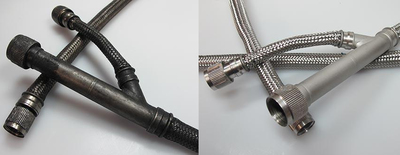
In a case study involving stainless steel and plastic conduit hydraulic pipe line, contaminated with general dirt, grease, dried de-icing fluid, and carbon dust, a two-stage ultrasonic process was used:
 |
1. Ultrasonic cleaning — parts were processed for a 20-minute cycle at 70°C using a 5% concentration cleaning agent, with the basket lifted and re-immersed midway through the cycle to dislodge settled debris.
2. Rinse — components were transferred to a deionised water rinse tank at 30°C and manually agitated to ensure a thorough, residue-free finish.
The process was first validated on a single pipe before being scaled up to batches of five or more per cycle, achieving 100% satisfactory cleaning with no etching. For higher volumes, Kemet recommends pairing ultrasonic cleaners with a fluid filtration system to extend fluid life as debris accumulates.
Cleaning Wheels, Brakes, and Fuselage Parts
Beyond pipework and titanium structures, aerospace MRO providers also face the challenge of cleaning wheel bearings, bolts, brake parts, and large aluminium fuselage sections — often within strict environmental, health, and safety requirements.
For wheels and brakes, a modular cleaning line combining spray washing, ultrasonic immersion, and rinse/rust-prevention stages allows bearings and small parts to be cleaned to a consistent standard in one centralised process, with closed-loop filtration reducing liquid consumption and environmental impact.
For fuselage parts, cleanliness before and after NDT is essential to ensure a chemically clean, dry surface that allows any cracks to be reliably detected. Kemet's approach combines jet pre-cleaning with ultrasonic cleaning and deionised water rinsing, with manual intervention available for intricate geometries, followed by hot air drying and full process data logging — before parts proceed to FPI for final crack and defect detection.
The Kemet Approach
Across all these applications, the common thread is a process built for traceability, repeatability, and minimal operator dependency — supported by automatic tuning of ultrasonic generators, smart water recycling, and encrypted remote technical support available to customers worldwide. For aerospace manufacturers and MRO providers, this means cleaning processes that meet the industry's exacting standards while reducing rework, downtime, and environmental impact.
Kemet International Ltd has provided precision cleaning and surface preparation solutions to industry for many years and is a trusted partner to leading aviation manufacturing and MRO companies worldwide. For more information, contact sales@kemet.co.uk or +44 (0)1622 755287.