
The Midlands is home to a substantial cluster of aerospace industry supply chains and R&D assets, one of the largest in the UK and Europe.
Overall impact
The business success of Midlands aerospace companies and employees in global markets directly generates more than 36,500 jobs and and £3.5bn Gross Value Added (GVA) for the Midlands economy. When we include regional economic multiplier effects, over 105,000 Midlands jobs and £5.3bn GVA are created by the revenue brought into the region by Midlands business sales in global aerospace markets. This means that aerospace is responsible for 2.0-2.3% of the regional economy.
Detailed analysis
Applying a measure that focuses on core aerospace industry supply chains and allows for consistency across the UK, the Midlands is home to 326 company sites that are either internationally recognised AS9100-accredited ‘Flying Parts’makers or AS9110- / AS9120-accredited ‘Maintenance, repair & overhaul / parts distributors’. These are effectively “gold standard” aerospace suppliers. Their sites are highlighted in the map below. This is more than double the share of UK aerospace sites (21% vs 10%) reported in official statistics (see below for discussion of different methodologies).
A somewhat broader definition adds specialist manufacturing companies that are not required to be accredited to the AS9100/10/20 standard, as well as other technically specialist, ‘indirect’ suppliers like those offering ‘NADCAP’ special services. This gives a total of at least 524 firms at 595 business sites in the specialist Midlands aerospace supply chain. That is nearly three times the number quoted in official statistics.
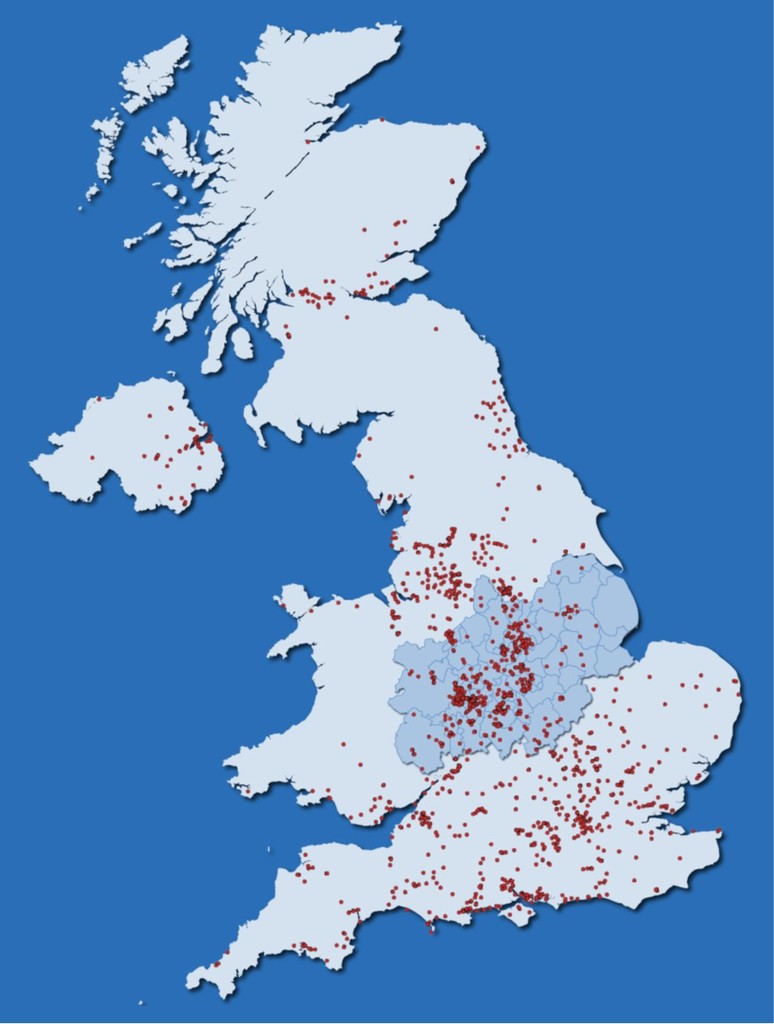
The Midlands has 326 AS9100/ AS9110/ AS9120 accredited company sites, 21% of the UK total.
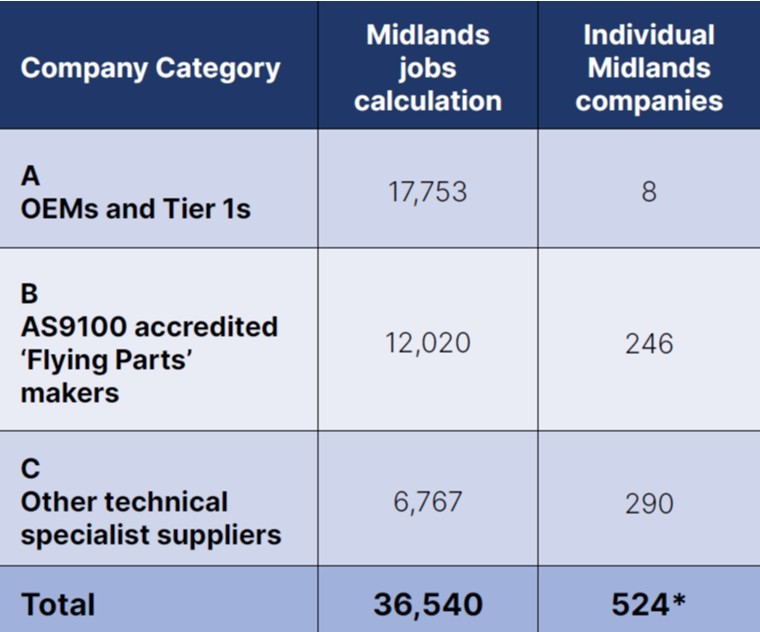
Companies and jobs across different parts of the specialist supply chain
Using a rigorous statistical methodology to adjust total job numbers at these companies downwards to account for the fact that many also supply other industries as part of the Midlands engineering supercluster, the 500+ companies employ 36,500 people in the region undertaking work for aerospace markets. This compares with the 20,000 jobs officially reported. About half these jobs are at the Primes/Tier 1s, one third at AS9100 “Flying Parts” makers, and one sixth at other specialist aerospace sites. Many jobs at these companies are highly skilled and well-paid.
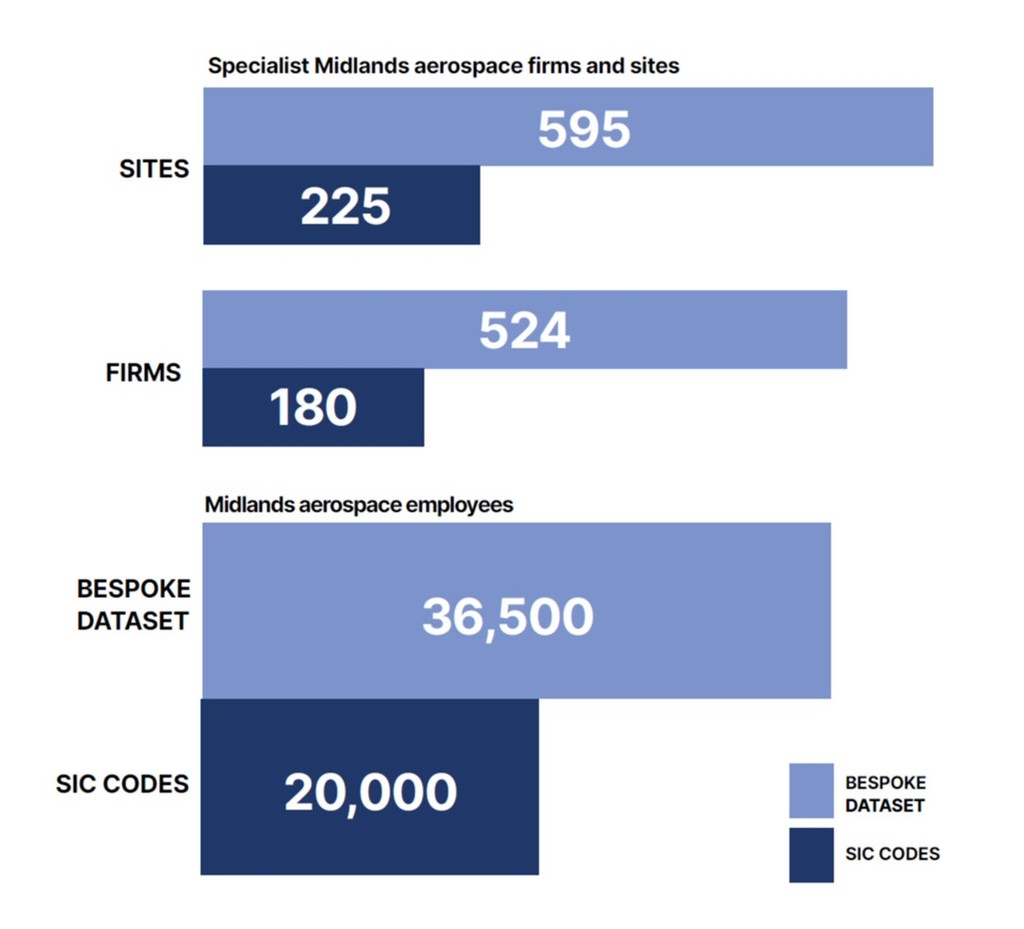
Numbers of sites, companies and jobs: comparing SIC data and our dataset
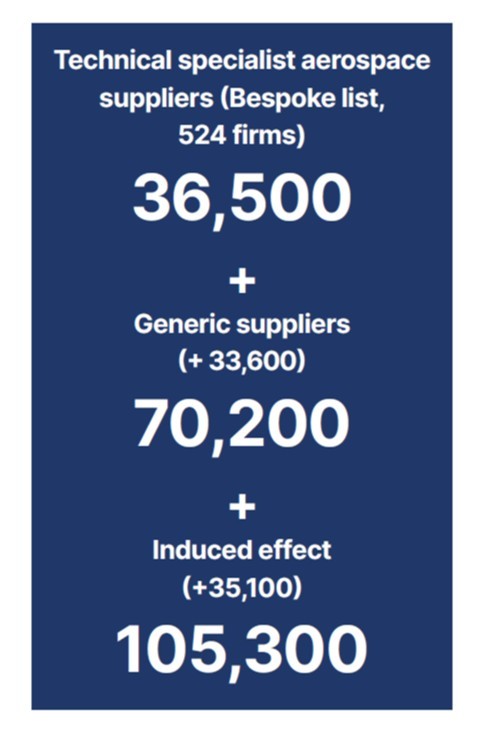
Regional economic multipliers reveal the aerospace cluster’s overall impact on jobs.
Implications for policy makers
The extensive company dataset reported on here is a rich resource for use in the sector regionally in the years ahead, providing a basis for an even deeper understanding of the Midlands aerospace cluster and its varied technical capabilities and diverse range of supply chain companies.
It is important for Midlands and national policymakers to stay abreast of the economic and technology dynamics of the UK and global aerospace industry. We encourage them to work with the regional cluster to exploit future opportunities and to support continued growth across supply chains..
Methodology: quantifying the size and contribution of aerospace in the region
The Midlands Aerospace Alliance worked closely with the regional development body "The Midlands Engine" (since closed down by government) to undertake the underlying research.
Oficial statistics that UK national and regional bodies traditionally rely on are well known to be poor indicators of the extent and reach of the aerospace sector, leading to uncertainty about its real economic contribution. Statistics based on Standard Industrial Classification (SIC) codes clearly under-estimate its size because many aerospace companies are classfied by what they do, e..g. "manufacturers," not by which markets they serve, e.g. "aerospace". SIC data suggest the Midlands has about 20,000 aerospace jobs (1/5 of UK) in 180 companies (1/10 of UK) across 225 sites.
Providing a more accurate assessment of the economic contribution of aerospace in the Midlands was therefore a key objective of the research. Critical to achieving this was the development of a new, comprehensive and detailed dataset of all companies known to be part of - or serving - the aerospace industry in the region. We believe this dataset to be the first of its kind in the industry. It was collated through an extensive bottom-up methodology, which gives us the basis for an accurate understanding of the size and scale of aerospace in the Midlands in terms of businesses and jobs. Our dataset-driven method gives a more realistic foundation for assessing the aerospace contribution to the Midlands economy.
Technically specialist Midlands aerospace people and companies generate over £3.5bn Gross Value Added (GVA) for the Midlands economy.





.png)